
One of Chicago’s oldest churches is the spiritual home to Polish and Latine communities, who grapple with immigration raids in very different ways.
by Jorge Iván Soto
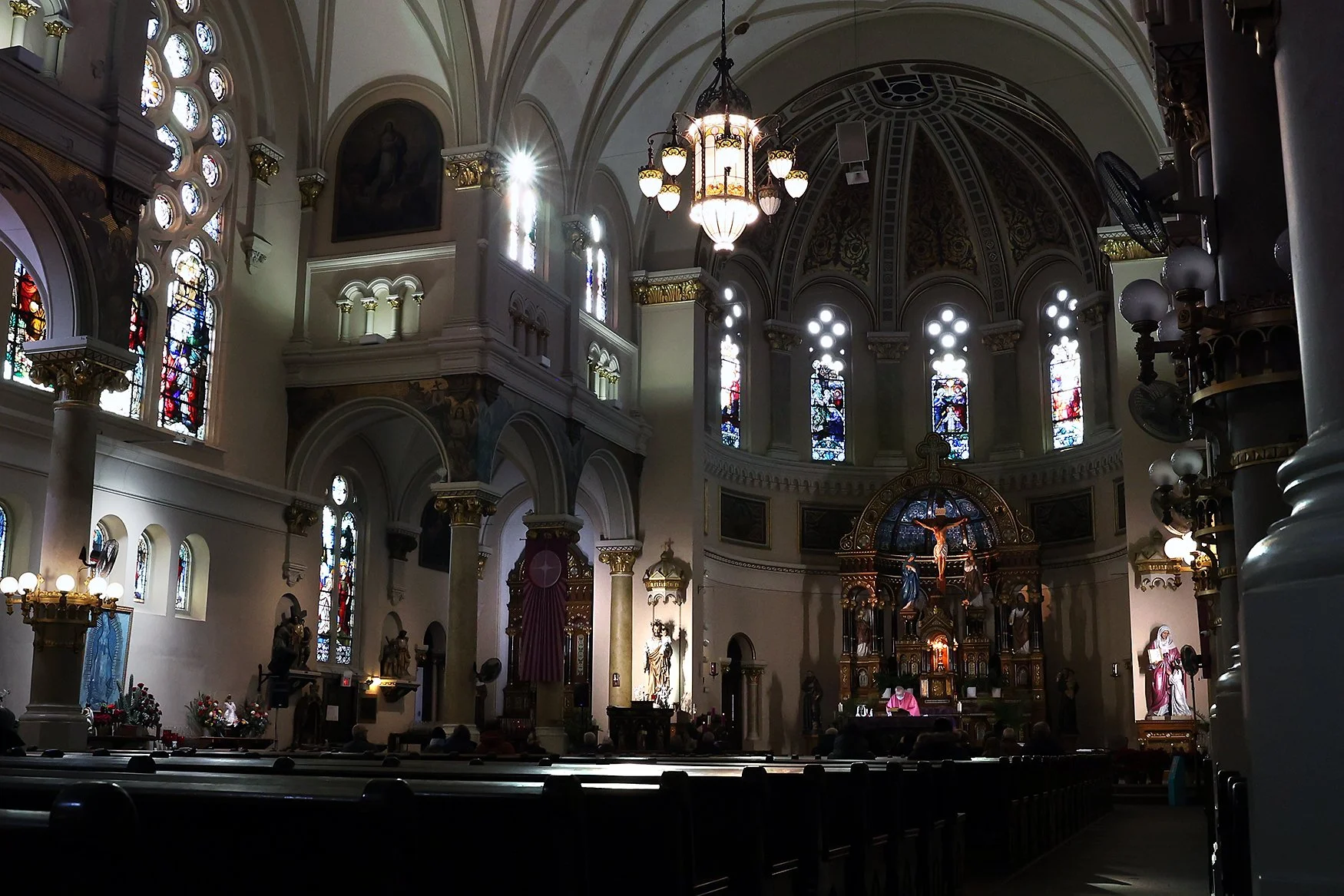
The priest of the Polish ministry leads prayer on Sunday, Dec. 14, 2025, at St. Joseph Parish in the Back of the Yards. (Anastasia Busby/City Bureau)
This story was published with Block Club Chicago on April 5, 2026.
It’s a cold Sunday morning in November, and Juanita Elías is going to church.
Attending Sunday mass at St. Joseph Parish at 48th Street and Hermitage Avenue is a ritual cemented into her weeks, her months, her 30 years in Chicago.
But on this particular day, she must attend without her husband, because Jorge Elías is missing. Federal immigration agents detained the 57-year-old Mexican father of two, and his wife is here, seeking the comfort her faith community can bring.
The crowd in the pews has thinned in recent weeks as Operation Midway Blitz sent a flood of federal immigration agents into Chicago’s streets, our schools, our grocery stores, our homes. Latine neighbors are afraid to go out in public, even to worship.
“It’s a really scary time for people,” said deacon Javier Pineda in Spanish. “Kids are no longer showing up for their catechism classes over fear of getting kidnapped.”
This morning, the Back of the Yards church is going through its usual turnover; as the Polish parishioners file out, others are arriving for the noon Spanish mass. Statues of la Virgen de Guadalupe and Pope John Paul II flank the altar, red leather kneelers before them worn with generations of prayers offered up on bended knees.
Weekly announcements now include news of which parishioners have been taken by federal agents with Immigration and Customs Enforcement or Customs and Border Patrol. Juanita Elías, 53, notices a shift after her husband’s name is read out.
“People who never used to greet you now greet you with so much love,” she said in Spanish. “They see me with compassion. And I’m doing the same: return that love to my community and continue supporting it. Whoever needs me, I’ll be there to help.”
It is this sense of community, of a safety net of care, that helps her and countless others through this terrible time. Faith-based community leaders on Chicago’s South and West sides are using their networks to organize and offer resources to parishioners who are under threat of ICE.
They are working in collaboration, expanding organizing efforts through groups such as the Peace and Education Coalition in Back of the Yards and the Coalition for Spiritual & Public Leadership, which extends from Chinatown into the west suburbs.
But here, at St. Joseph, where a diverse community of Polish and Latine parishioners come to worship, it’s clear there are split realities of impact and outcome. The work of these coalitions has just begun.
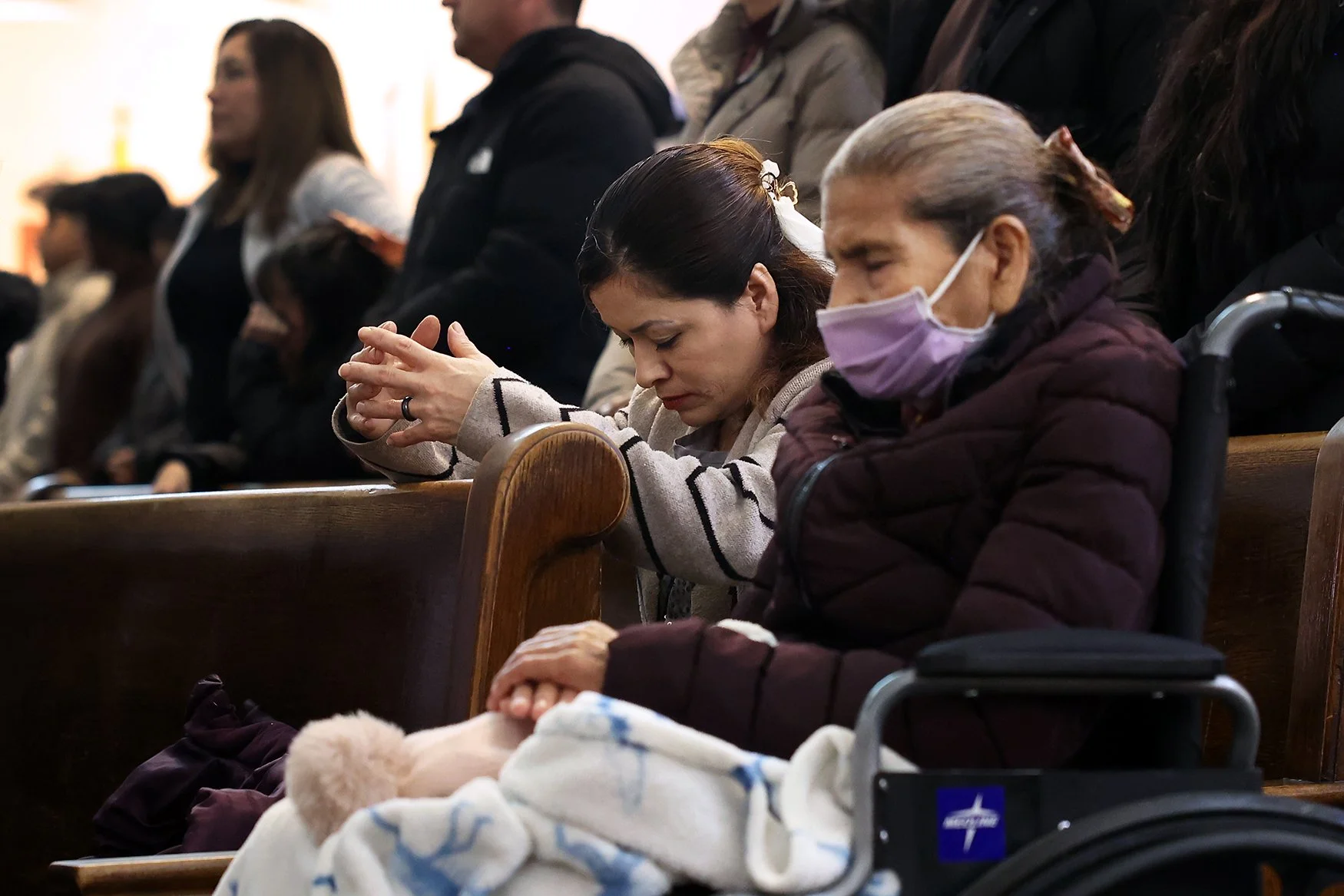
Estella Franco, from Indiana (left), prays during Mass on Sunday, Dec. 7, 2025, at St. Joseph Parish in the Back of the Yards. Franco came to Chicago with her family to visit her sick mother. (Anastasia Busby/City Bureau)
A neighborhood of immigrants
The makeup of St. Joseph Parish is mirrored in the history of its neighborhood.
New City, the Chicago community area that includes Back of the Yards and Canaryville, was settled largely by white European immigrants seeking work at the Chicago stockyards in the mid-1800s. The majority — but not all — of residents and stockyard workers were white.
Catholic parishes became community epicenters, as the Archdiocese of Chicago established nationality-based parishes to allow followers to worship with their shared language and traditions. St. Joseph Parish formed in 1887 as one of the first Polish Catholic churches in the neighborhood, then moved to its current building in 1914.
“The Polish and Mexican communities are more similar than you think, particularly around the family and religious traditions,” said Dominic Pacyga, a Back of the Yards native and professor emeritus at the University of Illinois Chicago. “We both hold our family and [Catholic] faith to a high regard, and value intergenerational living at home.”
But the relationship between different ethnic groups wasn’t always friendly, said Pacyga, who has written books including “Polish Immigrants and Industrial Chicago: Workers on the South Side, 1880-1922.”
“When Mexicans moved into the neighborhood in the 1920s, the Polish community was rather hostile,” he said. “Many of them refused to rent to Mexicans … a lot of the cops were Polish, and they would hassle the Mexican kids.”
As the stockyards’ use declined with the growth of interstate trucking in the 1950s and ’60s, New City — which at that point was around 95% white — lost 20,000 residents between 1940 and 1970, according to U.S. Census data.
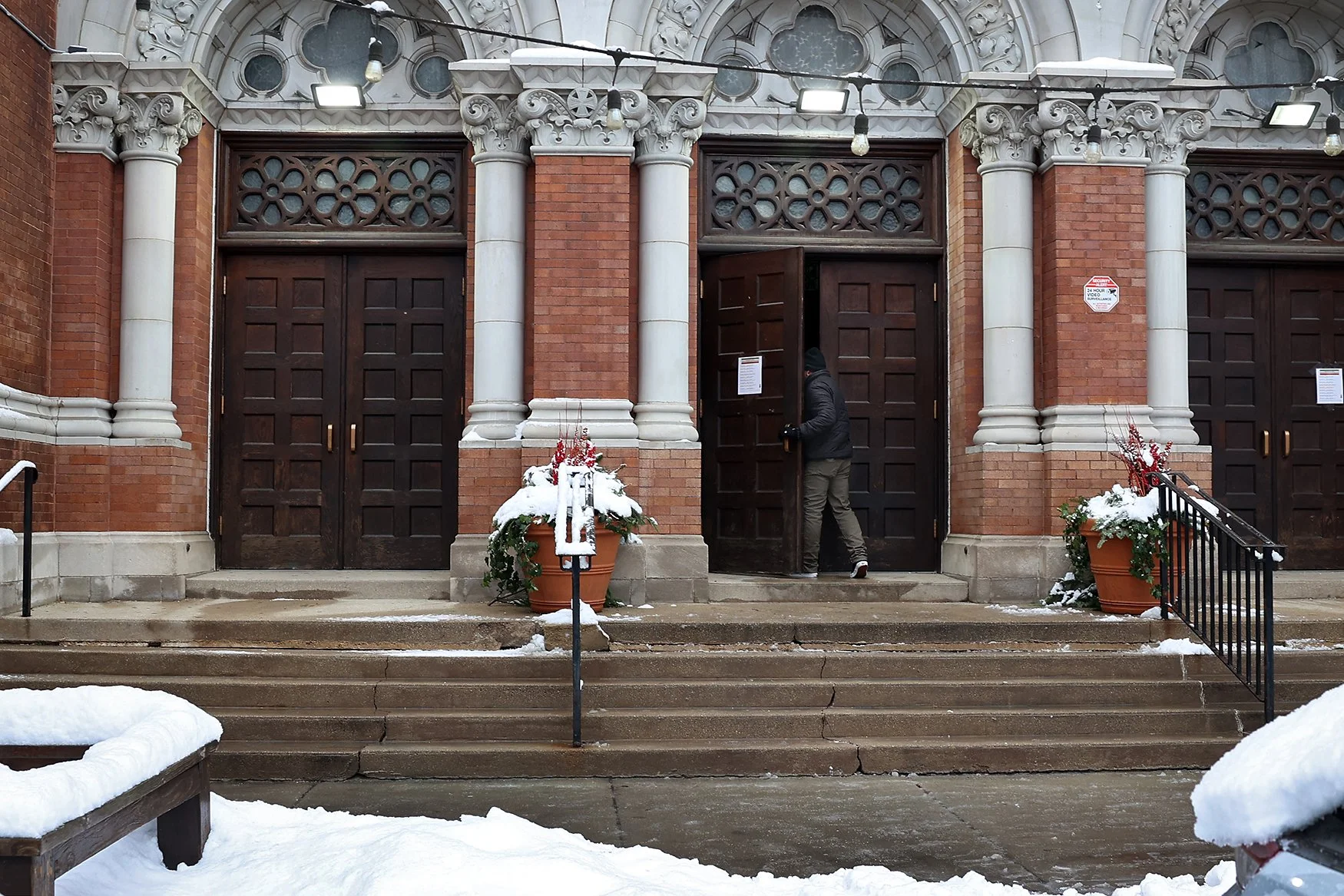
Someone walks through the doors for Mass on Sunday, Dec. 7, 2025, at St. Joseph Parish in the Back of the Yards. (Anastasia Busby/City Bureau)
In the following decades, Hispanic and Black newcomers filled the void — among them, Jorge and Juanita Elías, who came from Michoacán, Mexico, in the early ’90s to escape public violence and mistreatment by her dysfunctional family.
Over time, new generations found their shared religion brought them together.
“By the time I was there, we thought of Mexicans as just another ethnic group. They were Catholic, like us,” Pacyga said.
Daniel Pogorzelski’s father worked in a meatpacking plant alongside Mexican workers, he said. “They had this language between each other that took elements of English, Polish and Spanish — a lot of funny or crude phrases — to communicate with each other” on the factory floor, said Pogorzelski, who volunteers at the Polish Museum of America and has worked as a Polish translator through his union organizing roles.
By 2000, New City was 50% Hispanic and Latine, and 35% Black. The percentage of Latine residents continued to grow, accounting for almost seven in 10 residents, according to 2023 estimates.
At the same time, the archdiocese consolidated its churches in 2021. St. Joseph welcomed Catholics left without their original place of worship, and became part of the larger St. Oscar Romero Parish along with two other New City neighborhood churches: Holy Cross-Immaculate Heart of Mary and St. Michael the Archangel.
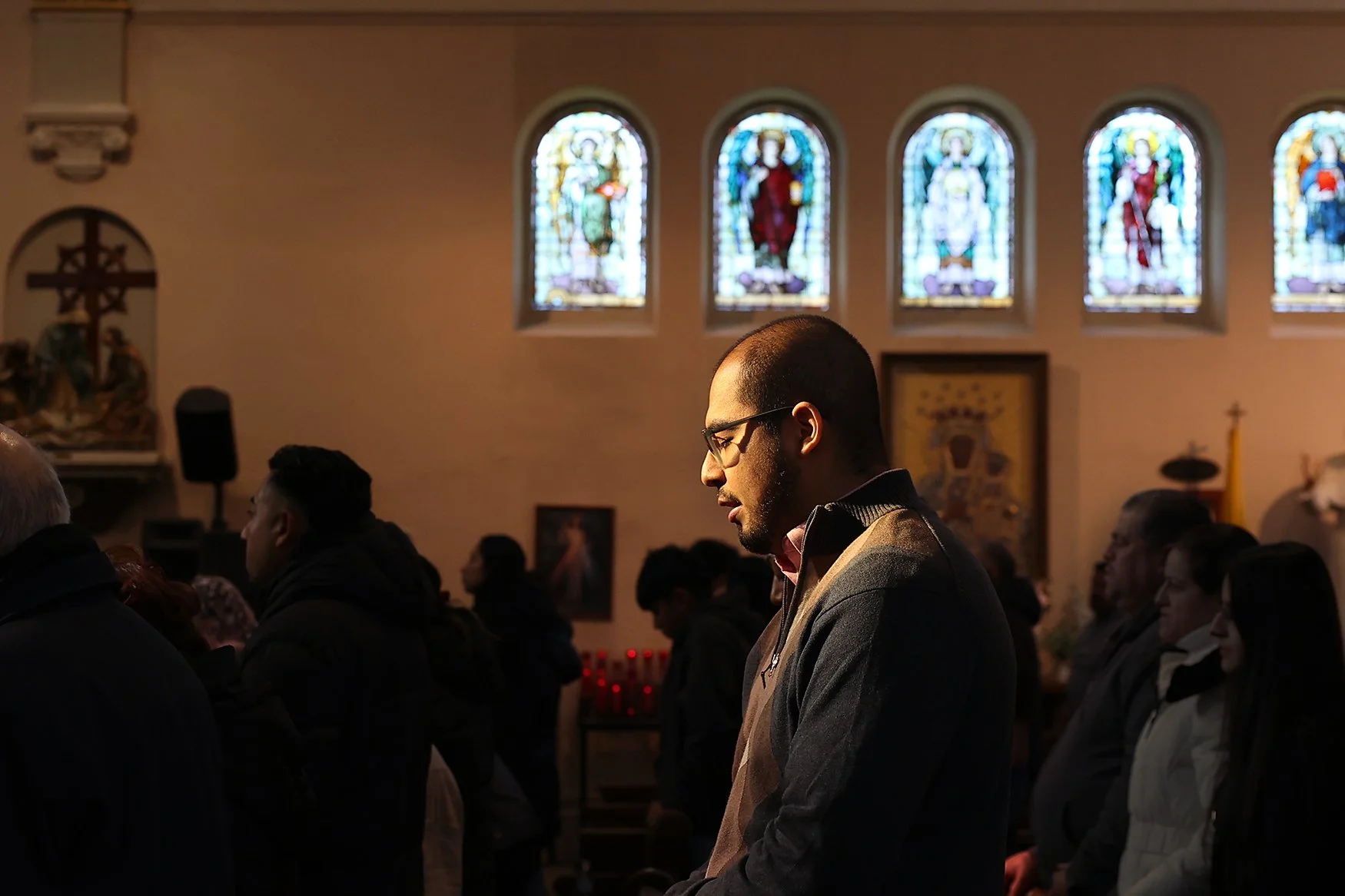
José Trejo sings during Mass on Sunday, Dec. 14, 2025, at St. Joseph Parish in the Back of the Yards. Trejo is a lector for the church. (Anastasia Busby/City Bureau)
‘They couldn’t help me’
It was this connection of parishes that led Juanita Elías to Gabriel Lara.
Her husband had arrived at a meeting place for work Nov. 11, but instead of his boss, ICE agents arrived and arrested him, she recounted.
“I still get goosebumps when I remember how my daughter was crying,” when the family heard the news, Juanita Elías said. “I was shocked by the immense pain it caused her. I think as an adult, you’re more prepared, but when you see your children’s hearts breaking, it’s the most traumatic and stressful thing that can happen to you.”
Jorge Elías’ boss had also been detained but was released, and it was his daughter who let the Elías family know. The Elíases’ daughter tried calling her father’s cell phone, and Jorge Elías picked up on the second try.
“We asked him where he was, and he didn’t know,” Juanita Elías said. “He said they were taking him away, but that was all, because they immediately hung up on him.”
The couple had applied in March 2025 for a pathway to legal residency based on the harassment Juanita Elías experienced from her family in Mexico, but the process is expected to take two years, she said. While they navigate that, her husband has a temporary work permit and has no criminal record, she said.
Juanita Elías began calling lawyers, but didn’t have the roughly $1,000 retainer fee — or details on where her husband was being detained.
“They told me they couldn’t help me, because I had to find out where he was,” she said.
The family tried searching for him on federal databases, but the government shutdown in October and November was making it hard to get results in real time. Jorge Elías told them he was in Michigan, but he didn’t know where, his wife said.
After two weeks, Lara, who directs the choir at St. Joseph, reached out to the family once he realized the Elíases’ son had been missing his music lessons at St. Michael the Archangel. He found out through the church about Jorge Elías being detained.
“He was a huge angel to us,” Juanita Elías said of Lara. “I don’t know how to repay him.”
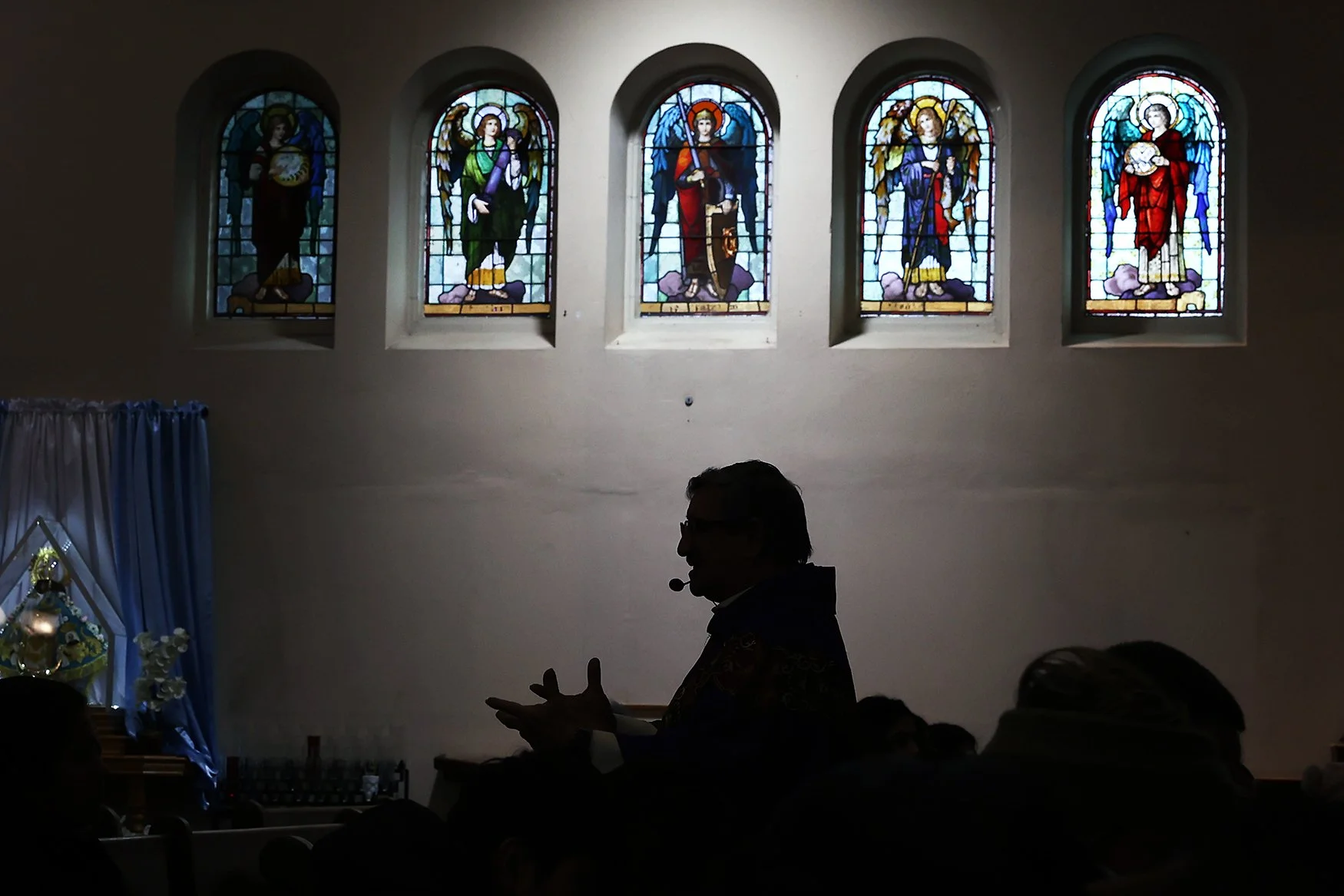
Father Pedro Antonio Lopez addresses the congregation on Sunday, Dec. 7, 2025, at St. Joseph Parish in the Back of the Yards. (Anastasia Busby/City Bureau)
Lara, 49, of Chicago Lawn, is the senior membership animator and formator at the Coalition for Spiritual & Public Leadership. The Chinatown-based organization launched in August 2017 with a mission of building “liberative and democratic systems” through spiritually rooted communities. Over the years, it grew to include 54 institutions and has organized know your rights training for immigrants, “smart routes” school walk initiatives, census outreach and childcare for all advocacy.
As part of CSPL, the St. Oscar Romero parish organized a procession from New City to the immigrant detention center in suburban Broadview, Lara said in Spanish.
“This was a way for them to take to the streets and ask for God’s presence, but also to peacefully — as the prophetic voice says — point out the institutional sin that is happening,” he said. “It was about countering the narrative that [ICE agents] are supposedly going after criminals and all that, which is false. Who are they arresting? The mother of the children, this man, or these families we all know who have done nothing wrong.”
Immigration agents have been active in Chicago long before Donald Trump’s first administration; however, St. Joseph parishioner Jose Trejo, 29, noted differences between 20 years ago and ICE tactics over the past year.
“Back then, you would be able to identify the truck, the enforcement officers, and where people were being taken to,” Trejo said. “Now they’re hidden. They’re in unmarked vehicles with tinted windows.”
As Operation Midway Blitz was underway, organizers canceled the popular El Grito festival in September, and rapid response teams monitored the annual Mexican Independence Day parade to help keep people safe and document any arrests. No ICE activity was reported that day, though people remained wary. When vehicles brandish Mexican and other Central American flags, “you would hear [of] officers also carrying the same flags to blend in and take people,” Trejo said.
In response, faith-based community leaders activated their networks across Chicago to organize and offer resources to parishioners. CSPL leveraged its regional reach to assemble lawyers who could help people with loved ones detained by ICE, and to host trainings on how church leaders could accompany parishioners to court for support.
Lara connected Juanita Elías with a lawyer whose rates were heavily subsidized and gave the family donations from CSPL.
After almost two months, her husband was released and returned home, she said. His deportation hearing was pushed to May 2027, when an immigration judge will determine whether Jorge Elías will be deported, his wife said.
“The truth is, we haven’t gotten over the shock of everything we went through, and my husband hasn’t recovered from the trauma,” Juanita Elías said. “But from all the bad, the good thing that has come out of it is that our faith has been strengthened. Our faith in God is stronger because we experienced His infinite love for us.”
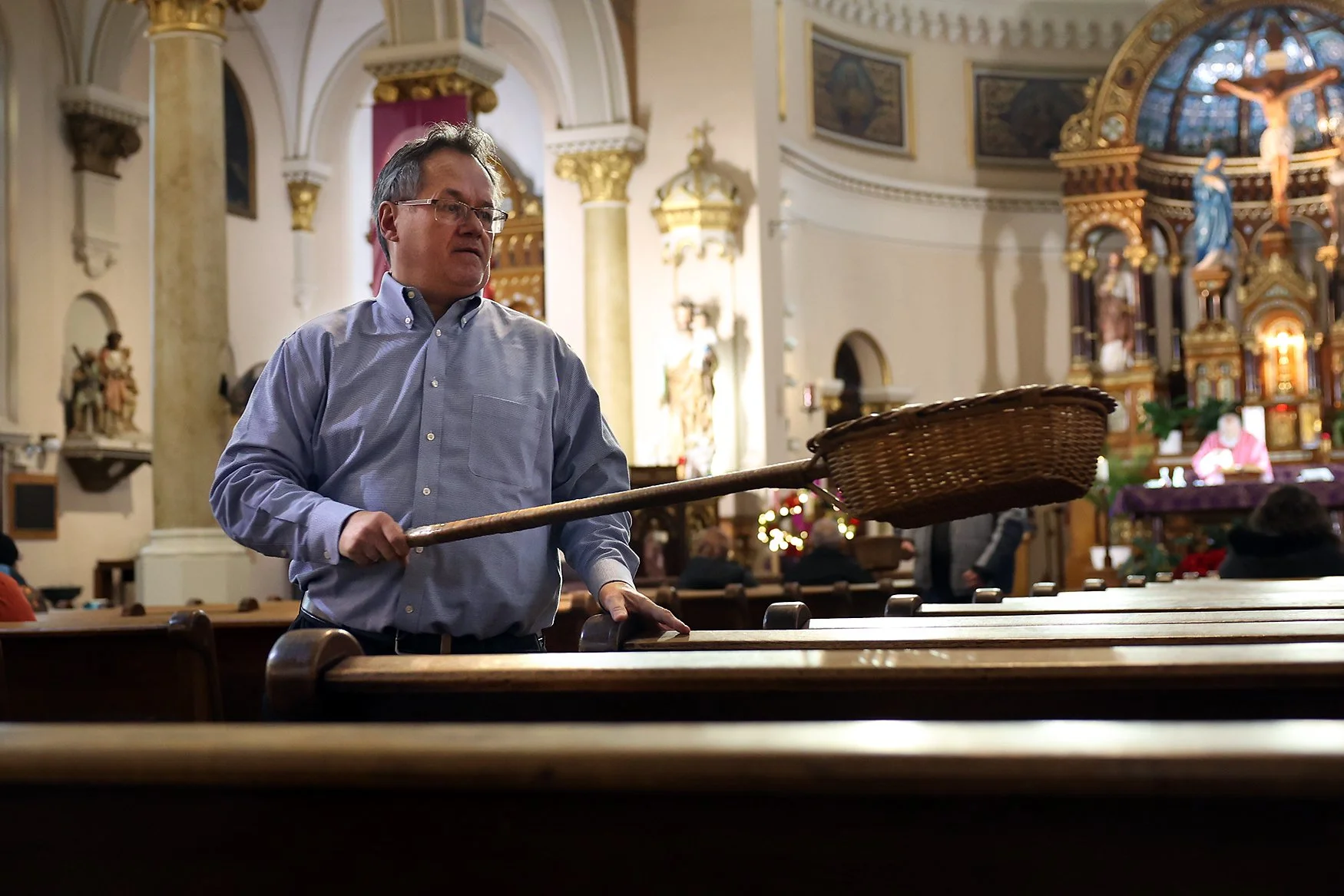
Mark Wojciechowski, head of the Polish ministry, collects donations during Mass on Sunday, Dec. 14, 2025, at St. Joseph Parish in the Back of the Yards. Wojciechowski has held a leadership position at the church for 30 years. (Anastasia Busby/City Bureau)
Shifting target
A few generations ago, immigration enforcement targeted a very different sector of Back of the Yards, said Mark Wojciechowski, 53, who went to school at St. Joseph and grew up to work in its administration for a decade.
After his parents emigrated from Poland during World War II, his father worked in factories that were the targets of raids, he said. Over presidential administrations ranging from Reagan to Obama, Wojciechowski has seen many different approaches to immigration enforcement, but “it wasn’t as inhumane as this [administration] appears,” he said.
“Now this new wave of ICE is basically targeting anyone who looks Latino,” Wojciechowski said. “They’re not really going after Chinese, they’re not going after Polish. It’s unfair to truly have [focus on] just one type of person.”
And while the Department of Homeland Security, which oversees ICE and CBP, claims to have targeted violent offenders and criminals, a Chicago Tribune analysis found just 1.5% of those detained in Operation Midway Blitz — 28 out of 1,895 — had been convicted of a violent felony or sex crime.
“In reality, you’re hitting up a tamale lady, which is not a criminal,” Wojciechowski said. “So it doesn’t make any sense.”
With less fear of being targeted, some of the parish’s Polish community joined in finding ways to help their fellow worshippers, Wojciechowski said. When a boy in his son’s catechism class was close to tears over worries he would miss class because his parents couldn’t leave the house, for example, parents immediately offered carpool rides.
But more could be done to strengthen the church’s cross-cultural relationships — and the archdiocese's response to ICE as a whole, he said. To him, it’s part of what it means for a church to be a sanctuary.
More coordinated community alerts regarding ICE activity, scholarship programs and fundraisers to help the Back of the Yards community in its entirety would be long-term ways to further boost support for church members in times of need.
“I think a lot of people are wondering, ‘What can I do? How can I help?’” Wojciechowski said. “And there could be better coordination, better working together.”
In October, Cardinal Blase Cupich, the city’s archbishop, released a statement declaring “the church stands with migrants.”
“Our parishes and schools will not turn away those who seek comfort, and we will not be silent when dignity is denied in the enforcement of the law,” he said. “It is essential that we respect the dignity of every human being.”
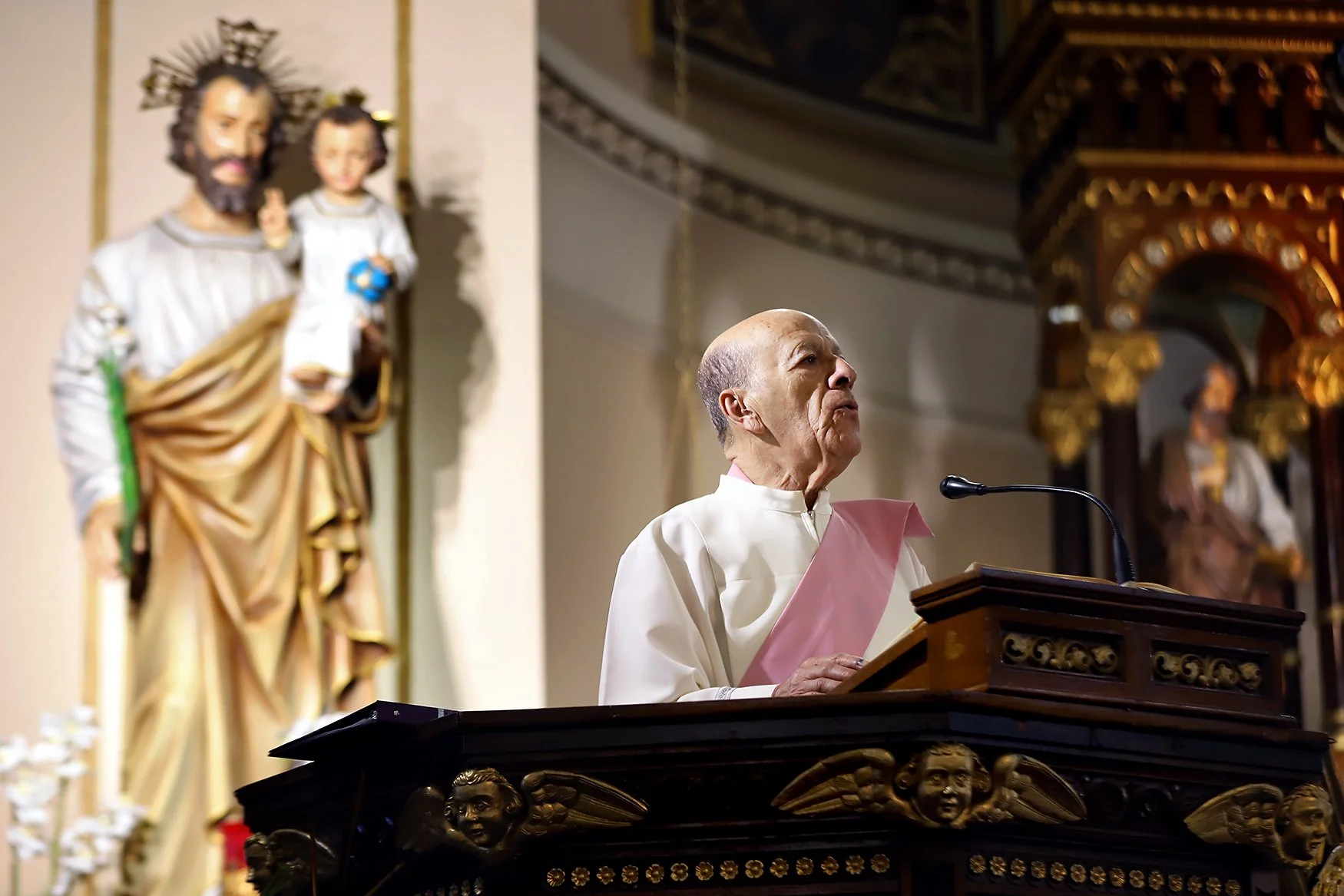
Deacon Javier Pineda reads to the parishioners on Sunday, Dec. 14, 2025, at St. Joseph Parish in the Back of the Yards. (Anastasia Busby/City Bureau)
Nevertheless, the Work Continues
Churches are one of the few gathering places left where you can find a vast range of generations coming together — which spreads to the advocacy work being done here, as well.
High schoolers volunteer after school to don green vests and walk around 47th Street passing out whistles, information about immigrant rights, and phone numbers for help lines for anyone detained by ICE, said Leonel Martinez, 22.
St. Joseph also hosts gatherings of teens, men and other cohorts to encourage them to “have the spirit of Jesus within us, to be more proactive and help others,” Martinez said.
While some parishioners have taken precautions in hopes of staying safe from ICE, other members have stepped up to provide updates as to the whereabouts of ICE and organized food drives for parishioners and community members, said St. Joseph deacon Pineda.
Young community members use Instagram and secure group chats on Whatsapp and other social media to communicate about ICE sightings and share them with older family members, Martinez said.
And while Operation Midway Blitz has been on pause during the winter, ICE enforcement has persisted. While it does, St. Joseph’s parishioners will keep finding ways to show up for one another, Pineda said.
“[God is] not going to save us from this, but we do believe this nightmare will have an end. We don't know when or where, but … this is an evil that can’t continue any longer,” he said. “We need to have hope, we need to do whatever we can to protect ourselves, and help the next generation in the best way that we can.”
One community
One block north of St. Joseph, Supermercado La Raza has been a neighborhood mainstay for four decades. It has stood as a beacon to greet visitors with a vivid mural on its side that declares, “Welcome to Back of the Yards” in elegant cursive.
But two new-construction homes built in the past couple years on a formerly empty lot obscure the majority of the artwork. Its depiction of Holy Cross-Immaculate Heart of Mary and a Hispanic woman offering a basket of food remain visible, but the rest is hidden away — a Mexican dancer and guitarist are bordered by flowers that shift to traditional Polish floral designs, joined by more dancers, this time in Polish folk outfits.
In some ways, the mural embodies what makes Back of the Yards and Chicago great — the shared history and communal spirit of generations of people who came here looking for a better life.
And even if it isn’t as visible as it could be, it’s still there, ready to reveal itself to those willing to look.
Siri Chilukuri and Ariel Cheung contributed.
Jorge Iván Soto is an Indigenous Mexican-American advocate and musician. In his Iowa hometown, they began writing op-eds and speaking on local media to advocate for the local factory workers affected by the COVID-19 outbreak. He sketches buildings, bikes and advocates for housing and public transit. He plays league soccer and DJs at local gigs. They are part of the Civic Reporting Fellowship cohort for fall 2025.
Support City Bureau’s Civic Reporting fellowship by becoming a recurring donor.